
You’re standing in a DIY store staring at rows of locks. Or, you’ve just searched online and been hit with pages of confusing terminology.
Mortice locks. Euro cylinders. BS3621. Anti-snap.
What does it all mean? And which one do you actually need?
Most of us don’t think about our locks until we move house, lose our keys or start worrying about security after hearing about a local break-in. But choosing the right lock affects more than just security. It influences your insurance premiums, how convenient your home is to access, and whether your doors will actually function properly day-to-day.
At Grays Locksmiths, we help Nottingham homeowners navigate these decisions regularly. The good news is that once you understand what the main lock types do and where they work best, the choice becomes much clearer.
Here’s what you need to know about the locks available for your home and how to work out which ones suit your situation.
Understanding British Standard locks
If you take away just one thing from this article, make it this: BS3621 matters. This British Standard is the benchmark that insurance companies look for when they assess your home security. Without it, you might find your insurance policy won’t pay out if you’re burgled.
BS3621 locks have been tested to resist picking, drilling and physical attacks for specific time periods. They’re built differently from basic locks, with more pins, anti-drill plates and stronger components throughout. When a lock meets this standard, you’re getting genuine protection rather than just something that looks secure.
The testing process is rigorous. Locks must withstand multiple attack methods that burglars commonly use, and they need to prove they can resist these for set durations.
This means you’re buying something that’s been independently verified to perform under real-world conditions.
Many insurers now make BS3621 locks a requirement for home insurance to be valid. If you’re unsure whether your current locks meet this standard, check for the British Standard Kitemark. It’s usually stamped on the lock faceplate.
Many older properties across Nottingham still have locks installed in the 1980s or earlier, long before these standards existed. If your locks predate the 1990s, they probably don’t offer the protection you’d expect from a modern lock. Upgrading doesn’t always mean replacing everything. Sometimes we can improve your security by replacing cylinders or adding compliant locks alongside what you already have.
Mortice locks for wooden doors
A mortice lock fits into the door itself rather than sitting on the surface. You’ll recognise the rectangular metal faceplate on the door edge, with the keyhole either on its own or alongside a handle.
There are two main types you’ll encounter. Five-lever mortice deadlocks operate with a key from both sides and don’t have handles. You’ll typically see these on back doors, garages or as additional security on front doors. They’re pure security. No convenience features, just a solid deadbolt that locks into your door frame. Mortice sashlocks combine a latch and deadbolt in one unit, operated by handles and a key. These are what you’ll usually find on front doors where you want to open the door from inside without constantly using a key, but still lock it securely when you leave.
The number of levers in the lock matters. Each lever is a separate obstacle that needs to be overcome to pick the lock. Two or three-lever mortice locks offer minimal security and won’t meet insurance requirements. Five-lever versions provide much better protection and are what you need for external doors. Some high-security mortice locks have six or seven levers, though five is generally sufficient for domestic properties.
Your door needs to be substantial enough for a mortice lock. These locks require a pocket cut into the door, so thin or hollow doors simply won’t work. The door would become structurally weak. Solid wooden doors are ideal. You’ll also need to match the lock depth to your door thickness, otherwise it won’t fit properly or won’t provide adequate security.
Despite being traditional technology that’s been around for over a century, quality mortice locks remain one of the most secure options available when properly installed. They’re mechanical, so there’s no technology to fail or hack. They’re robust and can last decades with minimal maintenance.
Euro cylinder locks for uPVC doors
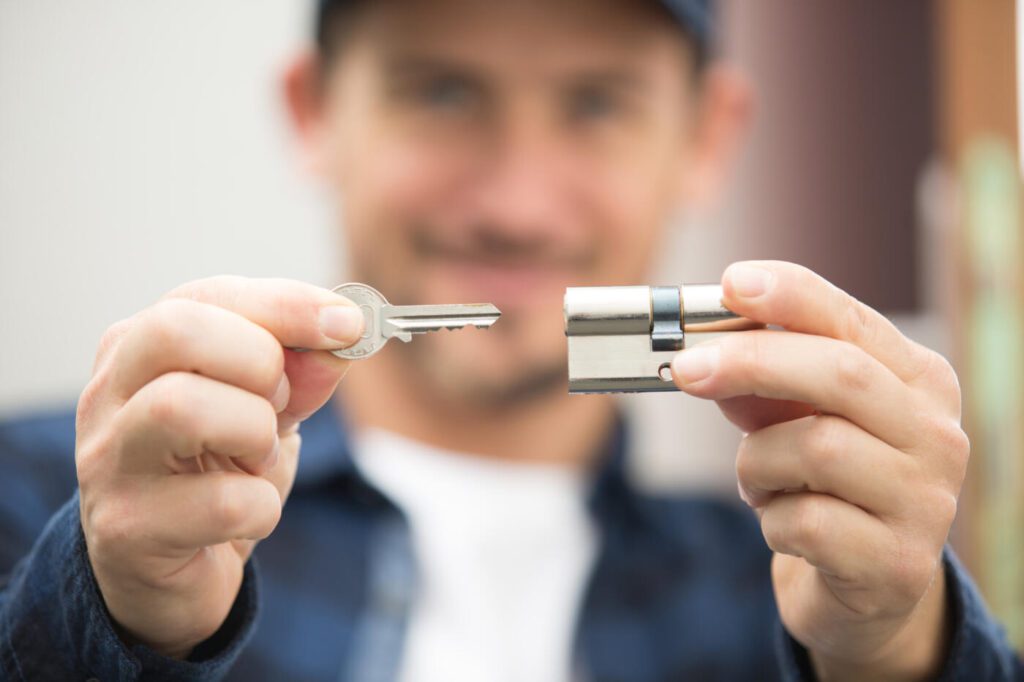
Most modern uPVC doors, composite doors and many newer wooden doors use euro cylinder locks. If your door locks at multiple points when you lift the handle and turn the key, you’ve got a multi-point locking system with a euro cylinder.
The cylinder is the part you put your key into. When you turn it, the mechanism extends bolts into the frame at several points, typically at the top, middle and bottom of the door. This spreads the load and makes the door much harder to force than single-point locks.
However, euro cylinders have a specific vulnerability that burglars discovered and exploited widely. ‘Lock snapping’ involves applying force to the cylinder until it breaks, giving access to the internal mechanism. This became such a problem that it made national news, and the lock industry responded with anti-snap cylinders.
Anti-snap cylinders have breakpoints built in. If someone tries to snap the cylinder, it sacrifices an outer section rather than exposing the mechanism that opens your door. The burglar ends up with a piece of broken cylinder but no access to your home. Modern anti-snap cylinders also include hardened materials that resist drilling, and additional security pins that make picking much harder.
Replacing just the cylinder is often straightforward and much cheaper than replacing the entire lock mechanism. Your existing multi-point locking system can stay. You’re simply upgrading the vulnerable component to something more secure.
Nightlatches and rim locks
These are the surface-mounted locks that sit on the inside of your door, the traditional ‘Yale-type’ lock that many of us grew up with. You’ll see the cylinder on the outside and a latch case on the inside, usually with a small handle or knob.
They work with a spring latch that automatically locks when you close the door. From inside, you turn a handle or knob to open it. From outside, you use a key. This makes them convenient for daily use. No fumbling with keys every time you pop out to the bins or accept a delivery.
But convenience comes with limitations. The spring latch can sometimes be slipped with the right tools, particularly on older models. This is why nightlatches should never be your only security on external doors. Insurance companies know this, and most won’t accept a nightlatch alone as adequate security.
Protecting your home
Choosing the right locks might seem complicated at first, but it becomes clearer once you understand what different types do and how they match to your situation. Getting it right matters for both security and peace of mind. You deserve to feel safe in your own home.
At Grays Locksmiths, we’ve helped Nottingham homeowners navigate these choices for decades. We understand local properties, from Victorian terraces with original doors to modern builds with the latest uPVC systems. We can advise on the most appropriate locks for your home and install them to the standards your security deserves.
If you’re unsure about your current locks or are planning an upgrade, call us on 0115 942 2315. We’ll help you understand exactly what you need and why, with no pressure to buy products that don’t suit your circumstances. Your home security is too important to get wrong.