
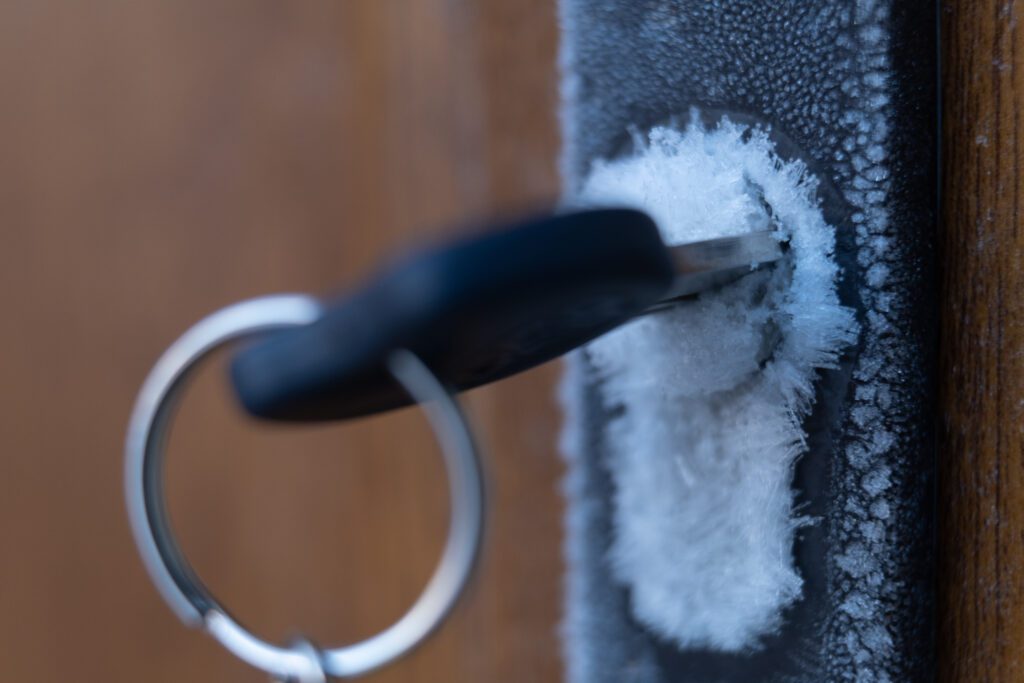
You’re already running late for work when you discover your key won’t budge in the lock.
The temperature dropped overnight, and now you’re standing in the cold, desperately jiggling a key that refuses to turn.
Your coffee’s getting cold in your hand, and you can feel the panic rising as you wonder if you’ll need to force it, call someone for help, or somehow break into your own home.
If you’ve found yourself in this situation, you’re not alone.
Frozen locks are one of the most common winter callouts we handle at Grays Locksmiths, particularly during those sharp cold snaps that catch everyone off guard. The good news is that you can often solve this problem yourself without damaging your lock or snapping your key, as long as you know what you’re doing.
We’ve helped hundreds of Nottingham residents deal with frozen locks over the years, and we’ve seen every possible outcome, from simple fixes that take seconds to expensive disasters that could have been avoided. Before you do anything drastic, take a deep breath and read through our guide. We’ll show you how to safely free your stuck key and, more importantly, how to stop it from happening again on another frosty morning.
Why locks freeze in winter
Your lock can freeze for several reasons. Understanding why it happens will help you tackle the problem more effectively. Most commonly, moisture finds its way into your lock mechanism through rain or accidentally splashing water near the lock. Even the condensation from your breath on cold mornings can contribute to the problem over time.
When temperatures drop below freezing, any water inside your lock turns to ice. Ice takes up more space than water, so it expands inside the delicate mechanism, blocking the pins and tumblers that need to move freely for your key to turn. The metal components of your lock also contract in cold weather, making the already tight tolerances even tighter. Add a bit of ice into the mix, and suddenly your perfectly functioning lock becomes completely seized.
Older locks suffer more from freezing because their worn mechanisms provide more spaces for water to collect. External locks, particularly those on garden gates, sheds and garages, face constant exposure to the elements and freeze more readily than your protected front door lock. Car door locks are especially vulnerable because they sit horizontally, allowing water to pool inside rather than drain away.
If you force your key when you feel resistance, you risk damaging the pins inside the lock or, worse, snapping your key off inside the mechanism. Once that happens, a simple frozen lock problem becomes a much more expensive broken key extraction job. We see this frequently during winter months, often from customers who thought a bit more force would solve the problem.
Dos and don’ts
When you realise your lock is frozen and your key won’t turn, your first instinct might be to force it. Please don’t. We can’t stress this enough. Forcing a key in a frozen lock is the quickest way to turn a minor inconvenience into a major problem requiring professional help.
Instead, try gently wiggling the key while applying steady, light pressure. Sometimes, this small movement is enough to break through thin ice formation. If you feel any flexibility in the key, or if it starts to bend even slightly, stop immediately. Modern keys are surprisingly brittle when cold, and they’ll snap with much less force than you might expect.
You might have heard that pouring boiling water over a frozen lock will solve your problem instantly. While it might work momentarily, you’re creating a bigger issue for yourself. The sudden temperature change can crack the lock casing, and worse, that water will refreeze, potentially making your lock even more frozen than before. The same goes for using a blowtorch or any other extreme heat source. You’ll likely damage the lock’s internal components or the surrounding door material.
Before you try anything else, check if you can access your property through another entrance. Your back door might be fine, saving you time and potential lock damage. If you’re dealing with a frozen car lock, try the passenger side or boot. Often, only one lock freezes while others remain functional.
Many people reach for WD-40 when they have a lock problem, but it’s not the solution you want here. While WD-40 might provide temporary relief, it’s primarily a water displacer, not a proper lock lubricant. It attracts dirt and dust, which will cause bigger problems once winter passes. Save it for squeaky hinges and use proper lock-specific products instead.
If you absolutely must try to remove the key and it won’t budge with gentle wiggling, don’t reach for pliers or any other tools. Gripping your key with pliers almost guarantees you’ll either damage the key’s teeth (making it useless even once the lock thaws) or snap it off entirely.
Safe methods to free your stuck key
The hairdryer method is one of the most effective ways to thaw a frozen lock safely. If you can run an extension lead outside, set your hairdryer to medium heat and hold it about six inches from the lock. Move it constantly to distribute the heat evenly. You’re aiming to gradually warm the entire lock mechanism, not blast one spot. After about 30 seconds, try gently turning your key. If it doesn’t move, continue heating for another 30 seconds. Most locks will free up within two to three minutes of gentle warming.
If you don’t have access to a hairdryer, hand warmers or heated cloths work well. Microwave a damp cloth for 30 seconds (check it’s not too hot to handle), then hold it against the lock. You’ll need to reheat it several times, but this method gives you good control over the temperature. Those chemical hand warmers you might have for winter sports are perfect. Activate one and hold it against the lock for a few minutes. The sustained, gentle heat gradually melts the ice without any risk of damage.
Lock de-icer spray is something we recommend every household keeps handy during winter. Spray it directly into the keyhole. You’ll need quite a bit, so don’t be shy with it. The alcohol-based formula has a lower freezing point than water, so it melts ice on contact while temporarily preventing refreezing. Give it at least 60 seconds to work through the mechanism before attempting to turn your key. For car locks, you might need to spray both the keyhole and around the edge of the lock where ice forms.
If you can see the keyhole clearly, try working graphite lubricant into the mechanism. Graphite works at extreme temperatures and won’t freeze or thicken like oil-based products. Squeeze the powder into the lock, insert your key partially if possible, and work it gently back and forth to distribute the graphite. This method works particularly well if your lock is only partially frozen.
For minor freezing, simply breathing on the lock for a minute or two might generate enough warmth to free things up. Cup your hands around the lock to trap your warm breath. It sounds too simple, but we’ve seen it work countless times for locks that are just beginning to freeze.
What to do if the key breaks
If you hear that distinctive ‘snap’ of a breaking key, don’t panic. First, carefully examine how much of the key is protruding from the lock. If you can see at least 5mm sticking out, you might be able to extract it yourself using needle-nose pliers. Grip the key fragment firmly but gently, and pull straight out without twisting. If it doesn’t come easily, stop. You risk pushing it further in.
When the key breaks flush with the lock face or disappears inside, you’ll need professional help. We know it’s tempting to try fishing it out with tools, but you’ll likely push the broken piece deeper into the mechanism. Once that happens, extraction becomes much more complex and expensive. What might have been a straightforward removal job becomes a complete lock replacement.
If you need to call us to extract a key, have your address ready, know the type of lock if possible (or take a photo), and explain that the key is broken inside due to freezing. This information helps us bring the right tools and give you a more accurate quote. While you’re waiting, don’t leave your property unsecured. If possible, stay home or ask a trusted neighbour to keep an eye on things.
The cost of professional key extraction varies, but it’s almost always cheaper than replacing a lock you’ve damaged trying to DIY the extraction. Plus, we can usually cut you a new key on the spot and treat your lock to prevent future freezing.
How can Grays Locksmiths Nottingham help?
Dealing with a frozen lock doesn’t have to ruin your morning if you approach it with patience and the right technique. The methods we’ve shared will solve most frozen lock problems without any damage to your property. Just remember that forcing things when they’re stuck usually leads to bigger, more expensive problems.
If you’re worried about your locks freezing this winter, or you’re currently dealing with a frozen lock you can’t solve, give us a call on 0115 942 2315. At Grays Locksmiths, we provide 24/7 emergency services throughout Nottingham and the surrounding areas, and we’re always happy to help, whether that’s getting you back inside today or preventing problems tomorrow.