
There’s a particular kind of dread that comes with feeling your key give way mid-turn.
One moment you’re unlocking your front door. Next, you’re standing there with half a key in your hand and the other half somewhere inside the lock.
It’s one of those situations that feels catastrophic in the moment, but it’s far more common than you might expect. And in most cases, far more fixable than it first appears.
This guide walks you through what you can try yourself, when it’s time to call a professional, and how to make sure it doesn’t happen again.
Why do keys snap in locks?
Keys don’t usually snap without warning. There’s almost always a combination of factors building up over time. Metal fatigue is the most common culprit. Every time you use a key, the metal flexes slightly under the pressure of turning. Over years of daily use, this repeated stress weakens the metal until one day it reaches breaking point.
The quality of the key plays a big part, too. If you’re using a duplicate key rather than the original, there’s a reasonable chance it wasn’t cut with great precision. Poorly cut copies wear unevenly, develop small stress points, and are more prone to snapping than a well-made original or a key cut by a specialist locksmith.
Then there’s the lock itself. A stiff, dry, or worn lock puts far more strain on the key every time it turns. If you’ve noticed your lock getting harder to operate over the past few months, that resistance doesn’t just make life annoying. It’s putting your key under pressure it wasn’t designed to handle. In most cases, a snapped key is the result of a lock and a key both past their best, finally giving out at the same time.
What to do immediately, and what not to do
The first instinct for most people is to try to pull or push the broken piece, either attempting to grip it with their fingers or nudging it further in to see if anything happens. This is usually the worst thing you can do. Pushing the fragment deeper into the barrel turns a manageable extraction job into a much more difficult one. Resist the urge.
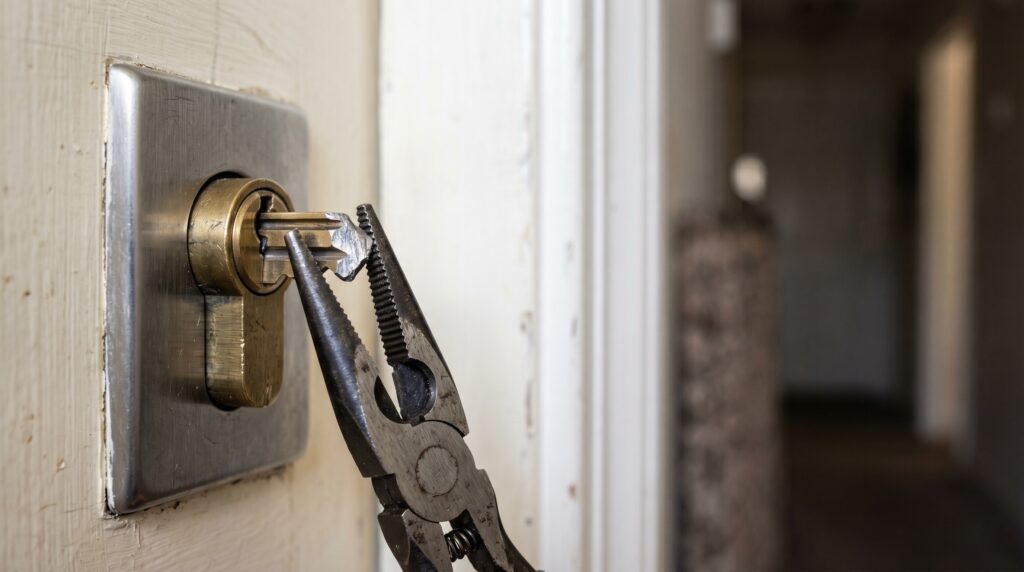
If part of the key is still protruding from the lock, even by a few millimetres, you might be able to perform a careful extraction with a pair of needle-nose pliers. Grip the fragment as close to the lock face as possible and pull in a straight line. Don’t twist or lever, as this risks snapping the fragment further or scoring the inside of the barrel.
There are cheap key extractor tools available online, and if you’re practically minded, you might be tempted to try one. They can work, but without experience, it’s easy to push the fragment further in or damage the lock mechanism in the process. Use with caution.
Whatever you do, don’t reach for the superglue. Bonding the two halves back together so you can pull the fragment out might sound plausible. In practice, it tends to bond the key to the inside of the lock, turning a broken key into a ruined lock. It’s a common mistake and an expensive one.
The general rule here is that patience and restraint give you the best outcome. Every attempt to force the situation risks making the damage worse.
Can you still lock your door while you wait?
If the key fragment is lodged inside the lock mechanism, the lock may not work in either direction, which makes it harder for anyone to open from the outside. But you shouldn’t rely on that as a security measure.
If you can lock the door by other means, like a second lock or a bolt on the inside, do so. If you can’t secure the property, stay put rather than leaving it unattended while you wait for help. A locksmith can often extract the broken key and restore the lock to full working order without needing to replace it, so help is closer than it might feel in that moment.
When to call a locksmith
If the key has snapped flush with the lock face, or the fragment has gone deep into the barrel, this is the point to call a professional rather than persist with any attempts at DIY. A locksmith has specialist extraction tools designed specifically for this job. They grip and rotate the fragment out without damaging the lock mechanism or the door.
The reassuring news is that in most cases, a skilled locksmith can extract the broken key and leave your lock working as normal. Replacement isn’t usually necessary unless the lock itself is already worn or damaged. Calling sooner rather than later also reduces the risk of the fragment being pushed further in, which is particularly important if other members of the household might try to use the lock before help arrives.
At Grays Locksmiths, our engineers handle broken key extractions regularly and will always explore the least invasive approach before recommending any replacement work. Give us a call on 0115 942 2315, and we’ll talk you through your options.
What if your key is stuck but hasn’t snapped?
A stuck key is a related but slightly different problem. It’s worth covering here because the same anxiety applies, and the temptation to force things is just as strong.
If your key goes in but won’t turn, or turns but won’t come back out, start by gently wiggling the door itself while maintaining light pressure on the key. Doors settle and warp over time, particularly in older Nottingham properties, and sometimes, the latch or bolt sits under pressure against the frame, which prevents the mechanism from moving freely. Shifting the door slightly can release that pressure and free the key.
If the lock is stiff, a graphite-based lubricant can help. Don’t use WD-40. Despite it being many people’s go-to for anything mechanical, it isn’t ideal for lock mechanisms. It can leave a residue that attracts dirt and makes the problem worse over time. A proper graphite spray or lock lubricant is a better choice.
If neither of these works, stop forcing it. A stuck key that’s pushed too hard will break at some point. A locksmith can assess whether the issue lies with the key, the lock or the door alignment.
How Grays Locksmiths can help
A key snapping in your lock is stressful, but it’s one of the more routine jobs we deal with, and it’s rarely as bad as it feels in the moment. In most cases, we can extract the fragment cleanly, test the lock, and leave you secure without needing to replace anything.
As MLA-approved locksmiths serving Nottingham and the surrounding areas, we bring the right tools and the right training to every job. You can check our membership through the MLA website, and we’re always happy to talk through what’s happened before we come out.
If your key has snapped, give us a call on 0115 942 2315. We’ll get you sorted.